
One of the first questions homeowners, builders and dealers ask when planning new windows is simple:
How much will the windows cost?
The difficult part is that there is no single price for every uPVC window.
Two windows with the same width and height can have completely different quotations because the actual specification may be different.
The final cost can change depending on:
- Profile system
- Profile dimensions
- Window opening type
- Glass specification
- Reinforcement
- Hardware
- Gaskets
- Mesh
- Fabrication
- Installation
- Colour or finish
- Project size
- Site conditions
Current Indian market guides show wide price differences between basic, mid-range and premium uPVC window systems, with glazing, profile quality and hardware among the major cost variables.
So instead of asking only “What is the price per square foot?”, it is more useful to understand what you are actually getting for that price.
What Is the Typical uPVC Window Price in India?
The market does not have one fixed rate because uPVC windows are manufactured using different profile systems, glass combinations, hardware and fabrication specifications.
Recent 2026 Indian pricing guides show standard and premium systems spanning a broad range, with mid-range systems generally sitting between entry-level and premium configurations.
For example, current published guides show approximate market ranges such as:
| Window System | Indicative Market Range |
|---|---|
| Basic fixed windows | ₹250–₹550 / sq. ft. |
| Standard sliding windows | ₹350–₹700 / sq. ft. |
| Standard casement windows | ₹450–₹900 / sq. ft. |
| Premium systems | ₹900–₹1,500+ / sq. ft. |
These figures should be treated as market indications, not a fixed quotation. The final price depends on the exact profile, glass, hardware, reinforcement, fabrication and installation specification.
For a project quotation, an itemised specification is much more useful than a single per-square-foot number.
Why Does the Price Vary So Much?
The biggest mistake buyers make is assuming that every uPVC window is essentially the same.
It is not.
Think of a finished window as:
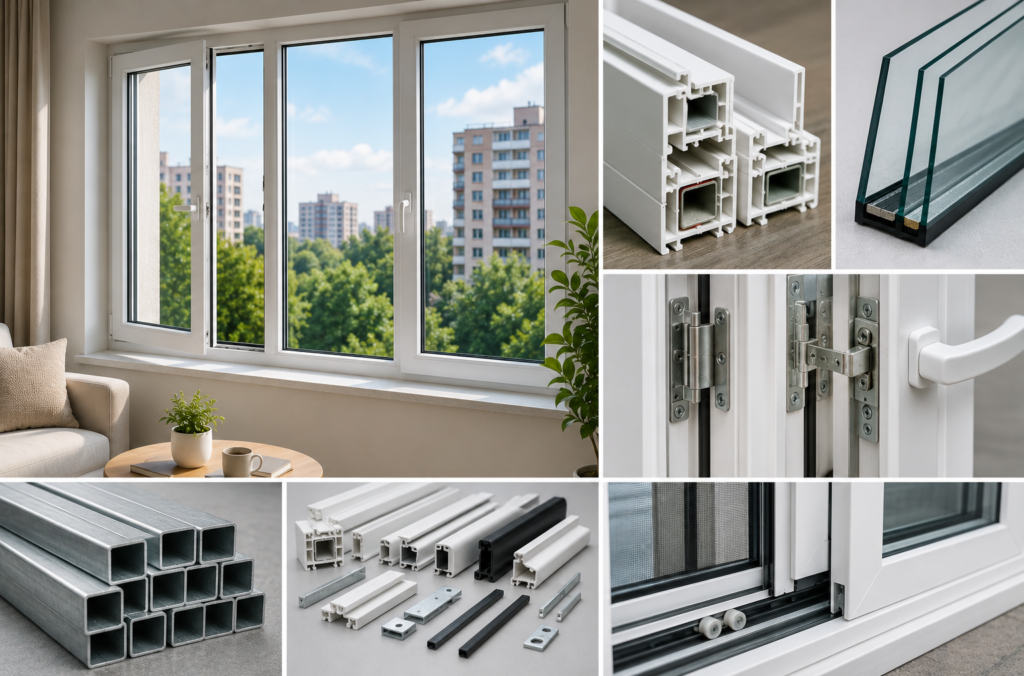
Profile + Reinforcement + Glass + Hardware + Gaskets + Fabrication + Installation
Changing any one of these components can change the final price.
1. Profile System Affects the Cost
The uPVC profile forms the basic structure of the window.
Different profile systems can have different:
- Dimensions
- Chamber configurations
- Wall geometry
- Reinforcement provisions
- Glazing capacity
- Hardware compatibility
- Auxiliary profile requirements
A basic profile configuration and a more engineered multi-chamber system should not automatically be compared as equivalent products.
The profile also needs to be suitable for the intended window size and application.
UWDMA recommends buyers examine profile specifications and related quality classifications rather than evaluating a window only by its appearance.
For fabricators, the better question is:
“Which profile system is suitable for this opening and fabrication requirement?”
rather than simply:
“Which profile is cheaper?”
2. Glass Can Significantly Change the Final Price
Glass is one of the largest variables in a finished window quotation.
Common options include:
Single Clear Glass
The basic glazing option for standard applications.
Toughened Glass
Provides improved safety characteristics and is commonly considered for larger or vulnerable glazed areas.
Double Glazed Glass
An insulated glass unit uses two panes separated by a spacer and sealed together.
Depending on the glass specification and complete window system, it can provide improved thermal and acoustic performance compared with basic single glazing.
Laminated Glass
Can provide additional safety and acoustic benefits depending on its construction.
Solar-Control or Low-E Glass
Can be considered where solar heat gain and indoor thermal comfort are important.
Current Indian pricing guides identify glass as one of the most significant variables in the final cost of a uPVC window.
This is why two vendors can quote very different prices for exactly the same window size.
3. Reinforcement Changes the Specification
uPVC profiles are hollow sections.
For applications requiring additional structural support, galvanized steel reinforcement can be placed inside a designated profile cavity.
The reinforcement requirement depends on factors such as:
- Opening dimensions
- Profile configuration
- Glass weight
- Wind load
- Window or door type
- Installation conditions
UWDMA specifically recommends checking galvanized steel reinforcement specifications and the static calculation used for the intended window or door size.
Why should buyers care?
A quotation that simply says:
“uPVC window with steel reinforcement”
does not tell you enough.
Ask:
- What reinforcement is being used?
- What thickness is specified?
- Which profile accommodates it?
- Where is it required?
- Is the reinforcement included in the quoted price?
For larger openings, these details become particularly important.
4. Sliding and Casement Windows Have Different Costs
The opening mechanism affects both material and hardware requirements.
Sliding Windows
Sliding systems use tracks, rollers and sliding sashes.
They are often selected where:
- Space around the window is limited
- Horizontal operation is preferred
- Wide openings are required
- Compact operation is important
Published Indian pricing guides generally place standard sliding systems toward the lower end of the market compared with more hardware-intensive opening types, although the final cost depends on the exact system.
Casement Windows
Casement systems use hinges or friction stays and can provide a larger openable area.
They can be suitable where:
- Maximum ventilation is important
- Stronger compression sealing is required
- Tall or narrow openings are being designed
- Full opening access is preferred
The profile, sash, hardware and glass configuration all influence the final quotation.
5. Hardware Is Often Overlooked
Hardware controls the actual operation of the window.
Depending on the system, it may include:
- Handles
- Locks
- Hinges
- Friction stays
- Rollers
- Multipoint locking systems
- Sliding mechanisms
Hardware quality can affect:
- Smooth operation
- Locking
- Security
- Durability
- Maintenance
- User experience
UWDMA recommends checking handles, locking systems, rollers, material specifications and operation when evaluating a uPVC window.
A low quotation may use basic hardware while another quotation includes a more sophisticated hardware package.
Therefore, hardware should always be included in your comparison.
6. Fabrication Is Part of the Window Cost
The profile does not arrive at the site as a finished window.
It must be fabricated.
A typical process involves:
Measurement → Cutting → Reinforcement → Welding → Corner Cleaning → Machining → Hardware Fitting → Glazing → Assembly → Inspection
Fabrication requires labour, machinery and technical accuracy.
The final cost can therefore change depending on:
- Window design
- Number of shutters
- Cutting requirements
- Welding
- Hardware installation
- Glazing
- Mesh
- Special shapes
- Project quantity
UWDMA’s fabrication guidance identifies cutting, welding, routing, corner cleaning, glazing and related production equipment as important parts of uPVC window manufacturing.
7. Installation Is Not Always Included
This is another common reason for confusing quotations.
One vendor may quote:
Profile + Glass + Hardware + Fabrication
while another may quote:
Complete Supply + Fabrication + Installation
These are not comparable prices.
Installation can involve:
- Frame positioning
- Mechanical fixing
- Shimming
- Perimeter sealing
- Waterproofing
- Grouting or finishing
- Removal of old frames
- Site-specific civil work
Current Indian cost guides also distinguish between supply pricing and installation or civil-work charges.
Always ask:
“Is installation included?”
8. Mesh Can Change the Cost
Mosquito mesh is commonly required for residential projects.
Depending on the system, mesh can be:
- Separate
- Integrated
- Sliding
- Fixed
- Rollable
- Part of a dedicated track configuration
A sliding window with an additional mesh track can therefore have a different profile and fabrication requirement from a basic two-track sliding window.
When comparing quotations, check whether mesh is included or charged separately.
9. Colour and Laminated Finishes Affect Pricing
Plain white profiles are generally the most straightforward option.
Other finishes may include:
- Grey
- Black
- Brown
- Golden Oak
- Mahogany
- Walnut
- Other laminated finishes
Colour and lamination can affect material cost, production requirements and availability.
If a quotation specifies a coloured or laminated profile, compare it with another quotation using the same finish before judging the price difference.
10. Window Size Affects More Than Material Quantity
A larger window does not simply require more profile.
Large openings can also influence:
- Reinforcement requirements
- Glass thickness
- Glass weight
- Hardware selection
- Sash configuration
- Transportation
- Installation method
This is why a 3 ft × 4 ft window and a 6 ft × 7 ft opening should not be compared using the same assumptions.
The larger opening may require a completely different system configuration.
How to Compare Two uPVC Window Quotations
Suppose Vendor A quotes:
₹550 / sq. ft.
and Vendor B quotes:
₹750 / sq. ft.
It would be a mistake to immediately conclude that Vendor A is cheaper.
First compare:
| Specification | Vendor A | Vendor B |
| Profile series | ? | ? |
| Profile dimensions | ? | ? |
| Chamber configuration | ? | ? |
| Reinforcement | ? | ? |
| Glass | ? | ? |
| Hardware | ? | ? |
| Gaskets | ? | ? |
| Mesh | ? | ? |
| Fabrication | ? | ? |
| Installation | ? | ? |
| GST | 18% | 18% |
| Warranty | ? | ? |
Only after these are clarified can you make a meaningful comparison.
Why the Cheapest uPVC Window May Not Be the Best Value
The lowest quotation can look attractive at the beginning.
But if the specification is reduced in areas that affect performance, the saving may not represent good value over the life of the window.
Potential compromises can involve:
- Lower-grade hardware
- Different glass
- Reduced reinforcement specification
- Basic profile configuration
- Limited auxiliary components
- Different fabrication standards
- Installation exclusions
The goal should therefore be:
Right specification + right fabrication + right installation
rather than simply:
Lowest initial price
What Should a Fabricator Look for Before Buying Profiles?
For fabricators, price is only one part of the purchasing decision.
A profile supplier should also be evaluated on:
Profile Consistency
Are dimensions consistent from batch to batch?
Fabrication Compatibility
Can the profile be efficiently cut, welded, reinforced and assembled?
Hardware Compatibility
Are commonly available hardware systems compatible?
Glazing Compatibility
Can the required glass and glazing beads be accommodated?
Reinforcement Provision
Does the profile provide the appropriate reinforcement cavity?
Auxiliary Profiles
Are connectors, adaptors and other supporting profiles available?
Supply Reliability
Can the supplier maintain consistent availability for ongoing projects?
These factors can directly influence fabrication efficiency and rework.
What Should Homeowners Ask Before Ordering?
You do not need to understand every technical detail.
Ask your window supplier these questions:
1. Which profile series are you using?
Get the actual series name.
2. What glass is included?
Ask for the glass type and thickness.
3. Is reinforcement included?
Ask what specification is being used.
4. Which hardware is included?
Ask about handles, locks, hinges and rollers.
5. Is mesh included?
If required, confirm the mesh type.
6. Is fabrication included?
Do not assume the profile price is the finished window price.
7. Is installation included?
Get this clearly mentioned in the quotation.
8. Is GST included?
Ask whether the quoted amount is before or after applicable taxes.
9. What warranty applies?
Clarify what the warranty covers.
10. What exactly is included in the final price?
Request an itemised quotation.
Is a More Expensive uPVC Window Always Better?
No.
A higher price does not automatically mean better performance.
The right system depends on the application.
For example:
A basic residential opening may not require the same specification as a large sliding door.
A bedroom near a busy road may have different glass requirements from a utility room.
A large villa opening may require more structural consideration than a small bathroom window.
A commercial project may prioritize fabrication efficiency and supply consistency.
Therefore, the correct question is not:
“Which is the most expensive window?”
It is:
“Which specification is appropriate for this opening and application?”
How Smart uPVC Window Profiles Fit Into the Cost Equation
Smart uPVC Window Profiles are positioned as a practical, medium-range profile solution from Ravi Raja Industries.
The focus is on balancing:
Durability + Fabrication Practicality + Project Cost
The profile range is developed for everyday window and door applications where fabricators need practical configurations for:
- Cutting
- Welding
- Reinforcement
- Glazing
- Hardware integration
- Assembly
The Smart range includes Casement, Premium Sliding, Eco and Auxiliary profile series, giving fabricators different profile configurations for different project requirements.
The objective is not to make every project use the same profile.
It is to provide practical profile options that can be selected according to the opening, application and project requirements.
A Simple uPVC Window Budget Checklist
Before approving a quotation, confirm:
- Profile series
- Profile dimensions
- Chamber configuration
- Reinforcement
- Glass type
- Glass thickness
- Hardware
- Gaskets
- Mesh
- Fabrication
- Installation
- Colour/finish
- GST
- Warranty
- Delivery
- Site-specific charges
This checklist can prevent most quotation misunderstandings.
Frequently Asked Questions
How is uPVC window price calculated?
It is generally based on the window area and the specification of the complete system. Profile, glass, hardware, reinforcement, fabrication, mesh and installation can all affect the final amount.
Why do two vendors quote different prices for the same window size?
Because the specifications may differ. Glass, profile system, reinforcement, hardware, fabrication and installation can all change the final cost.
Is sliding uPVC cheaper than casement?
Often, standard sliding configurations can have a lower starting cost than more hardware-intensive casement systems, but the actual price depends on the profile, glass, hardware and configuration.
Does double glazing increase the cost?
Yes. Double-glazed units generally cost more than basic single glazing, but they can provide improved thermal and acoustic performance depending on the complete system.
Is steel reinforcement included in every quotation?
Not necessarily. Always check the quotation and ask for the reinforcement specification.
Does window size affect the price?
Yes. Larger openings require more material and may require different reinforcement, glass, hardware and fabrication configurations.
Is installation included in the quoted price?
It depends on the supplier. Never assume it is included. Ask for supply, fabrication and installation to be clearly separated in the quotation.
How can I get an accurate quotation?
Provide the window sizes, opening types, required glass, colour, mesh requirements and project location. Ask the supplier for an itemised quotation showing profile, glass, hardware, reinforcement, fabrication and installation.