
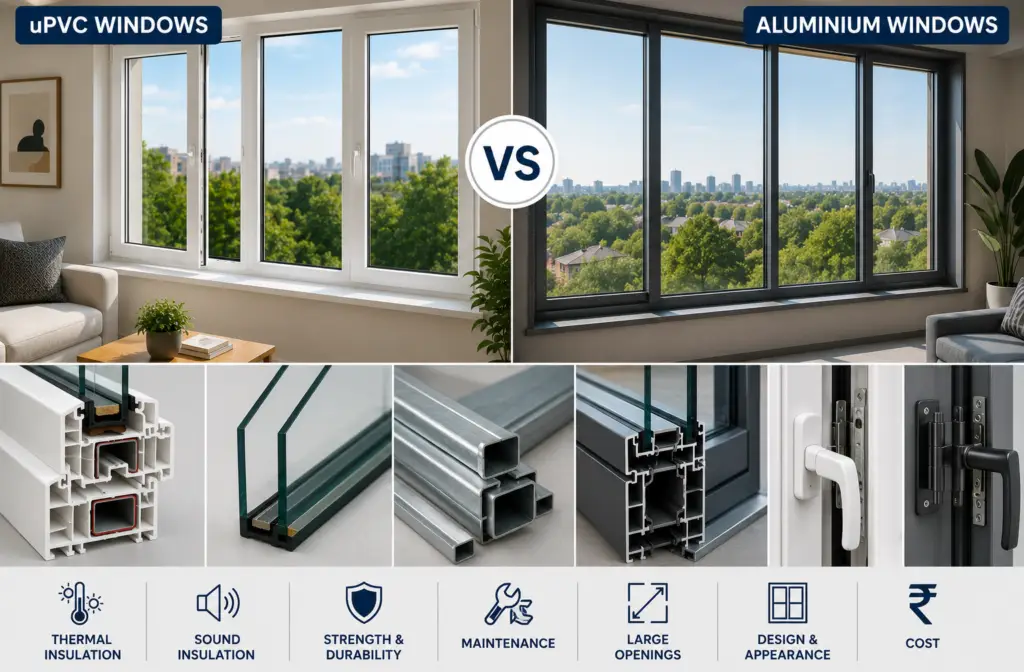
The answer is not simply one material for every project.
Both materials have their strengths. Aluminium is known for its structural strength, slim sightlines and ability to handle large glazed openings. uPVC is widely chosen for its thermal insulation, low maintenance and practical cost.
The real decision depends on what matters most for your project:
Heat control, noise, budget, opening size, appearance, maintenance, durability or fabrication requirements.
Current Indian comparison guides consistently identify thermal insulation, structural strength, glazing, design and price as major factors in the decision.
uPVC vs Aluminium Windows: Quick Comparison
| Factor | uPVC Windows | Aluminium Windows |
|---|---|---|
| Thermal insulation | Very good | Good with thermal break |
| Sound control | Very good with suitable glazing | Good with suitable glazing |
| Structural strength | Good with appropriate reinforcement | Excellent |
| Large openings | Suitable with correct system | Strong advantage |
| Maintenance | Low | Low |
| Corrosion resistance | Excellent | Depends on finish/environment |
| Profile appearance | Generally thicker | Usually slimmer |
| Design flexibility | Good | Excellent for slim designs |
| Initial cost | Often competitive | Varies widely |
| Reinforcement | Used where required | Structural strength comes from aluminium section |
| Fabrication | Cutting, welding and assembly | Cutting, machining and assembly |
| Best suited for | Homes, apartments, everyday projects | Large openings, slim architectural designs |
The important point is that glass, sealing, hardware, profile design and installation can affect final performance as much as the frame material itself.
1. What Is the Difference Between uPVC and Aluminium Windows?
The most basic difference is the frame material.
uPVC is an unplasticized polymer used to manufacture hollow, often multi-chambered profile sections.
Aluminium is a lightweight metal with naturally high structural strength.
That difference affects how the two systems behave.
uPVC’s multi-chamber construction helps reduce heat transfer through the frame, while aluminium can provide higher structural strength with slimmer sections.
This creates the first major trade-off:
uPVC focuses strongly on insulation and practical residential performance.
Aluminium focuses strongly on strength, slimness and architectural flexibility.
2. Which Is Better for Heat Insulation?
This is one of the biggest reasons homeowners consider uPVC.
uPVC has relatively low thermal conductivity, and multi-chamber profile construction helps reduce heat transfer through the frame.
This can be particularly useful in hot Indian climates.
However, there is an important point that is often missed:
The frame is only one part of the window.
Glass can have a major influence on the thermal performance of the complete window.
A basic single-glazed window and a properly specified insulated glazing unit should not be treated as the same system.
Current Indian guides identify glazing as one of the largest variables affecting both window performance and cost.
What about aluminium?
Standard aluminium is highly conductive.
But modern aluminium systems can use a thermal break, which separates the inner and outer aluminium sections with an insulating material.
This significantly improves thermal performance.
So the fair comparison is:
Standard uPVC vs standard aluminium: uPVC generally has the thermal advantage.
uPVC vs thermally broken aluminium: the performance gap can become much smaller.
3. Which Is Better for Noise Reduction?
If you live near:
- Busy roads
- Traffic junctions
- Construction areas
- Airports
- Railway lines
- Commercial streets
then acoustic performance becomes important.
But there is a common misconception:
The frame alone does not make a window soundproof.
The complete system matters.
Acoustic performance depends on:
- Profile design
- Glass specification
- Number of glass panes
- Glass thickness
- Laminated glass
- Gaskets
- Sealing
- Installation
- Gaps around the frame
uPVC can provide strong acoustic performance because of its profile construction and sealing characteristics, but aluminium can also perform well when correctly designed with suitable glazing and seals.
Practical conclusion
If noise is your main concern, do not ask only:
“Should I buy uPVC or aluminium?”
Ask:
“What profile, glass and sealing specification is being offered?”
That is the more useful question.
4. Which Is Stronger: uPVC or Aluminium?
This is where aluminium has a clear natural advantage.
Aluminium is a structural metal, so it can support large glazed areas with relatively slim sections.
uPVC profiles are hollow and can require internal reinforcement for applications where additional structural support is needed.
Reinforcement requirements depend on:
- Opening dimensions
- Wind conditions
- Glass weight
- Profile configuration
- Sash size
- Hardware loads
Current technical guidance emphasizes the importance of appropriate reinforcement for uPVC windows, particularly for larger openings.
Does that mean uPVC is weak?
No.
A properly specified uPVC system with appropriate reinforcement can be suitable for a wide range of residential and commercial applications.
The important point is:
Do not select a profile based only on appearance.
The opening size and application should determine the system.
5. Which Is Better for Large Windows?
If your project includes:
- Floor-to-ceiling glazing
- Very wide sliding doors
- Large balcony openings
- Large fixed glass areas
- Minimal sightlines
aluminium often becomes attractive because of its structural capability and slim profile options.
This is one area where aluminium can offer a strong architectural advantage.
For standard residential windows, however, properly engineered uPVC systems can handle many common opening sizes.
The decision should consider:
Opening size + glass weight + wind load + sash configuration + reinforcement + hardware
not simply the frame material.
6. Which Looks Better?
This is subjective.
But the visual difference is real.
uPVC
uPVC profiles generally have a more substantial frame appearance.
They work particularly well for:
- Residential homes
- Apartments
- Villas
- Traditional-modern architecture
- Practical replacement projects
Aluminium
Aluminium can achieve slimmer sightlines.
That makes it popular for:
- Contemporary architecture
- Large glass facades
- Minimalist homes
- Commercial buildings
- Premium architectural projects
Current comparisons also identify slim sightlines and architectural appearance as one of aluminium’s strongest advantages.
So if your primary goal is:
“I want the thinnest possible frame.”
Aluminium may be the better fit.
If your priority is:
“I want practical insulation, durability and low maintenance.”
uPVC can be an excellent choice.
7. Which Requires Less Maintenance?
Both materials are relatively low maintenance compared with traditional timber systems.
uPVC generally does not require regular repainting.
Basic care includes:
- Cleaning the frame
- Cleaning tracks
- Checking drainage
- Inspecting gaskets
- Maintaining hardware
Aluminium also requires relatively little routine maintenance, although finish and environmental exposure matter.
In coastal or highly humid environments, the aluminium finish and corrosion resistance should be considered carefully.
uPVC does not rust like conventional metal frames, which can be an advantage in humid environments.
8. What About Monsoon and Water Leakage?
This is another area where buyers sometimes blame the material when the actual problem is the system or installation.
A leaking window can result from:
- Blocked drainage
- Poor perimeter sealing
- Incorrect installation
- Damaged gasket
- Poor frame alignment
- Incorrect drainage design
Current maintenance guidance identifies blocked drainage slots and failed sealant among common causes of uPVC window leakage.
Therefore:
uPVC does not automatically mean leak-proof.
And aluminium does not automatically mean leak-prone.
The profile system, drainage design, sealing and installation all matter.
9. Which Is More Affordable?
This is where online comparisons can become misleading.
There is no universal price for either material.
The final price depends on:
- Profile system
- Profile size
- Glass
- Hardware
- Reinforcement
- Opening type
- Fabrication
- Installation
- Finish
- Project quantity
Recent Indian market guides show wide price ranges for both uPVC and aluminium, particularly because basic fabricated aluminium, engineered aluminium systems, basic uPVC and premium uPVC are often compared as though they are equivalent products.
The biggest pricing mistake
Comparing:
Basic aluminium + single glass
against
Multi-chamber uPVC + better glass + reinforcement + upgraded hardware
does not give you a meaningful material comparison.
Always compare the complete specification.
10. uPVC vs Aluminium: What About Electricity Bills?
This question usually comes down to heat transfer.
A window that allows more solar heat into a room can increase the cooling load.
uPVC’s lower thermal conductivity can help reduce heat transfer through the frame.
But again, the glass is extremely important.
A thermally efficient frame combined with poor glazing will not automatically produce a high-performance window.
Similarly, a thermally broken aluminium system with suitable glazing can perform very well.
So instead of asking:
“Which frame saves more electricity?”
ask:
“What is the thermal performance of the complete window system?”
11. Which Is Better for Hyderabad and Hot Indian Cities?
For hot Indian cities, thermal comfort becomes particularly important.
The practical considerations include:
- Strong sunlight
- High summer temperatures
- Dust
- Monsoon rain
- Outdoor noise
- Air-conditioning use
uPVC’s thermal insulation makes it attractive for many residential applications.
However, aluminium with an appropriate thermal-break system and suitable glazing can also be a high-performance option.
The choice should depend on the project’s:
Climate + opening size + glass + design + budget + performance requirement
not simply the city name.
12. uPVC vs Aluminium for Bedrooms
Bedrooms often benefit from:
- Thermal comfort
- Noise reduction
- Good sealing
- Easy operation
- Low maintenance
For these requirements, uPVC can be a practical choice.
If the bedroom faces a busy road, railway line or other noise source, prioritize the complete acoustic specification rather than choosing the frame material alone.
13. uPVC vs Aluminium for Living Rooms
Living rooms often have larger openings.
Consider:
- Opening width
- Ventilation
- Natural light
- Glass area
- View
- Noise
- Frame appearance
For standard-sized residential openings, uPVC can provide a practical balance.
For very large openings where slim sightlines are a major design requirement, aluminium may offer more flexibility.
14. uPVC vs Aluminium for Balcony Doors
Balcony doors are more demanding because the panels can become larger and heavier.
Check:
- Door dimensions
- Glass weight
- Reinforcement
- Hardware
- Track system
- Locking mechanism
- Drainage
- Installation
For very large sliding balcony doors, aluminium may have an advantage because of its structural strength.
For moderate-sized residential openings, properly specified uPVC systems can also be suitable.
15. Which Is Better for Fabricators?
This question is different from what a homeowner asks.
A fabricator needs to think about:
- Profile availability
- Cutting
- Welding
- Reinforcement
- Hardware compatibility
- Glazing
- Auxiliary profiles
- Assembly
- Rework
- Supply consistency
uPVC fabrication generally involves cutting and welding profile sections, followed by reinforcement, machining, hardware fitting, glazing and assembly.
The profile needs to be designed around the fabrication process.
That is why profile consistency and system compatibility matter so much to fabricators.
A technically good profile that is difficult to fabricate efficiently can create production problems.
16. Which Is Better for Dealers and Builders?
For dealers and builders, the decision is usually broader.
You need to consider:
Product range
Can the supplier provide the required window and door configurations?
Availability
Can the required profiles be supplied consistently?
Fabrication support
Can fabricators work efficiently with the profile system?
Project economics
Does the system fit the project’s budget?
Customer expectations
Does the system provide the appearance and performance the customer expects?
This is why a practical mid-range profile system can be valuable for projects that do not require premium architectural systems.
17. The Biggest Mistake: Comparing Only the Frame
This is probably the most important point in the entire article.
When people compare uPVC vs aluminium windows, they often compare only:
Plastic vs metal.
But a finished window is a system.
It contains:
Profile
Reinforcement
Glass
Gaskets
Hardware
Fabrication
Installation
A high-quality profile with poor fabrication can perform poorly.
A good aluminium section with poor sealing can leak.
A good uPVC profile with unsuitable glass may not deliver the expected acoustic or thermal performance.
The complete system matters.
uPVC vs Aluminium: Which One Should You Choose?
Here is the practical answer.
Choose uPVC when you prioritize:
- Thermal insulation
- Low maintenance
- Practical residential performance
- Noise control
- Cost-conscious projects
- Standard residential openings
- Everyday window and door applications
Choose aluminium when you prioritize:
- Slim sightlines
- Large glass areas
- Large openings
- High structural strength
- Minimal architectural appearance
- Premium facade design
Consider both when:
Your project has mixed requirements.
For example, a home might use uPVC for bedrooms and living-room windows while using a different system for very large architectural openings.
The right solution does not have to be the same throughout the entire building.
Where Smart uPVC Window Profiles Fit
Smart uPVC Window Profiles is positioned as a practical medium-range profile brand from Ravi Raja Industries.
The focus is on balancing:
Durability + Fabrication Practicality + Project Cost
Smart profile systems are developed for everyday window and door applications with practical requirements around:
- Cutting
- Welding
- Reinforcement
- Glazing
- Hardware integration
- Assembly
- Installation
The Smart range includes Casement, Premium Sliding, Eco and Auxiliary Series, allowing fabricators and project teams to select profile configurations according to their application.
The objective is not to make every project use the same profile.
It is to provide practical profile solutions for projects where dependable fabrication and controlled project cost matter.
Final Comparison
| If Your Priority Is… | Consider |
|---|---|
| Better frame-level thermal insulation | uPVC |
| Slimmest sightlines | Aluminium |
| Large glazed openings | Aluminium |
| Everyday residential windows | uPVC |
| Low maintenance | Both |
| Noise reduction | Both, with correct glazing |
| Hot climate comfort | uPVC or thermally broken aluminium |
| Large sliding doors | Aluminium or appropriately engineered uPVC |
| Budget-conscious projects | uPVC often offers strong value |
| Premium minimalist architecture | Aluminium |
| Fabrication-friendly everyday systems | uPVC |
Frequently Asked Questions
Is uPVC better than aluminium?
Neither material is universally better. uPVC generally has an advantage in frame-level thermal insulation and practical residential applications, while aluminium has advantages in structural strength and slim architectural designs.
Is uPVC cheaper than aluminium?
It can be, but it depends heavily on the profile system, glass, hardware, reinforcement, fabrication and installation. Comparing only the per-square-foot rate can be misleading.
Which is better for hot weather?
uPVC generally provides strong frame-level thermal insulation. Thermally broken aluminium can also provide good thermal performance, so the complete system should be compared.
Which is better for noise reduction?
Both can provide good acoustic performance when combined with appropriate glass, gaskets, sealing and installation. uPVC can have an advantage at the frame level, but glass specification is extremely important.
Which lasts longer, uPVC or aluminium?
Aluminium can have a longer service life in suitable conditions, while good-quality uPVC can also provide long-term residential performance. The actual life depends on material quality, exposure, hardware, installation and maintenance.
Is aluminium stronger than uPVC?
Aluminium has higher inherent structural strength. uPVC systems can use internal reinforcement where required to provide the necessary structural support for the application.
Which is better for large windows?
Aluminium generally has an advantage for very large openings because its structural strength allows slimmer sections. Properly engineered uPVC systems can still be suitable for many residential openings.
Which requires less maintenance?
Both are relatively low-maintenance. uPVC generally requires simple cleaning and periodic hardware, gasket and drainage checks. Aluminium also requires limited routine maintenance, with finish selection being important in demanding environments.
Does uPVC reduce electricity bills?
A well-designed uPVC window can help reduce heat transfer through the frame, but the complete window’s glass, orientation, shading, ventilation and installation also influence cooling performance.