
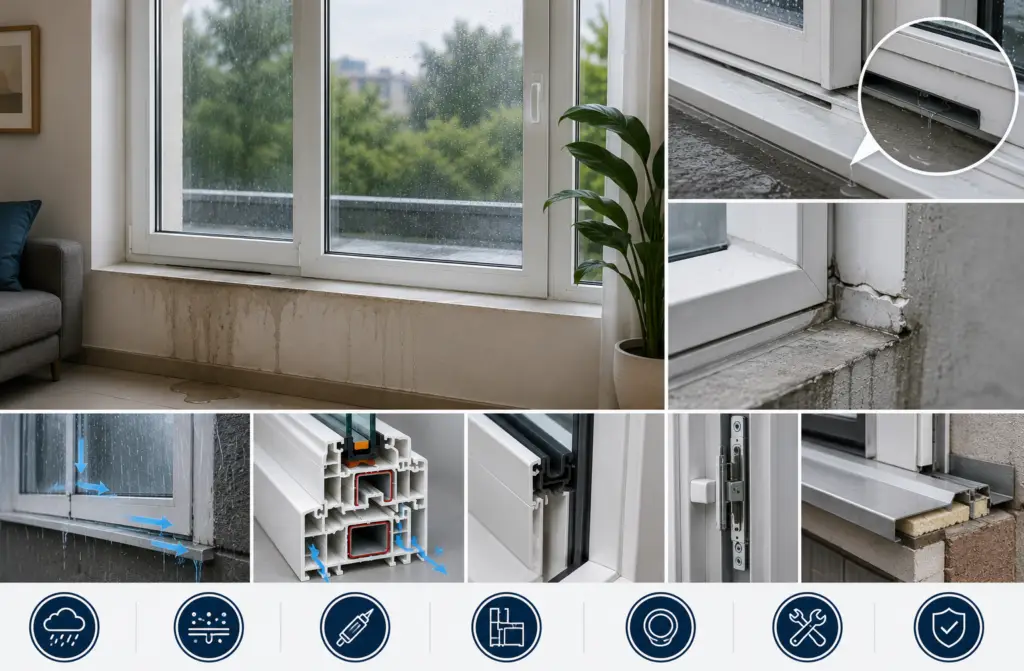
Heavy rain is one of the easiest ways to discover whether a window system has been properly designed, fabricated and installed.
You may notice water entering from the bottom of the frame, moisture around the corners, dampness near the wall or water collecting inside the sliding track.
This often leads to one question:
Why is my uPVC window leaking?
The important thing to understand is that a uPVC window is not just a frame.
It is a complete system consisting of:
Profile + Glass + Gaskets + Drainage + Hardware + Fabrication + Installation
A problem in any one of these areas can affect the finished window.
Recent Indian maintenance guidance identifies blocked drainage slots, failed perimeter sealant, deteriorated gaskets, misalignment and installation-related issues among common causes of water leakage.
So before replacing the entire window, it is important to identify where the water is actually coming from.
Why Do uPVC Windows Leak During Rain?
There are several possible reasons.
The most common include:
- Blocked drainage holes
- Incorrect drainage design
- Poor external sealing
- Incorrect frame installation
- Damaged or poorly fitted gaskets
- Incorrect window alignment
- Poor fabrication
- Water entering around the wall-to-frame joint
- Incorrect sill slope
- Excessive wind-driven rain exposure
A properly designed uPVC window should have a controlled path for water to drain away rather than allowing water to accumulate inside the frame.
Technical specifications used for institutional uPVC installations also emphasize drainage, sealing, reinforcement, fusion-welded corners and correct installation.
1. Blocked Drainage Holes
This is one of the simplest things to check.
uPVC window profiles are designed with internal chambers and drainage paths.
Rainwater can enter certain parts of the window system, but the drainage design should direct that water toward designated drainage openings.
If these openings become blocked with:
- Dust
- Cement
- Paint
- Construction debris
- Insects
- Dirt
water may accumulate inside the frame.
Eventually, it can overflow into the room.
What to do
Inspect the drainage openings along the bottom portion of the frame.
Make sure they are:
- Open
- Clean
- Not covered by sealant
- Not blocked by plaster
- Not obstructed by debris
Do not randomly drill additional holes into the profile without understanding the system design.
The drainage path is part of the profile system and should follow the manufacturer’s fabrication recommendations.
2. Poor External Sealing
The joint between the window frame and the building wall is another major area to inspect.
Even if the window itself is correctly manufactured, water can enter through the perimeter gap.
This can happen when:
- Sealant is missing
- Sealant has cracked
- The joint was not properly prepared
- The wrong sealant was used
- The frame was installed unevenly
- The external joint was not properly finished
Recent Indian guidance identifies failed exterior sealant around the frame perimeter as a common source of rainwater entry.
Important distinction
If water is entering between the wall and frame, the problem may be installation or perimeter sealing rather than the uPVC profile itself.
3. Incorrect Window Installation
A good profile cannot compensate for poor installation.
The frame needs to be:
- Correctly positioned
- Properly aligned
- Securely fixed
- Correctly sealed
- Properly supported
- Installed with appropriate drainage
Installation quality is particularly important in areas exposed to heavy rain and wind-driven rain.
A recent technical discussion of uPVC installation also highlights that poor installation can cause water leakage, noise and heat problems even when the underlying window system is good.
This is why installation should not be treated as a final cosmetic step.
It is part of the window’s performance.
4. Damaged or Poorly Fitted Gaskets
Gaskets create the sealing interface between the frame, sash and glass.
Over time, seals can:
- Harden
- Crack
- Shrink
- Become displaced
- Lose compression
This can create small gaps through which air and water can pass.
A current Indian maintenance guide notes that deteriorated gaskets can contribute to draughts and other sealing problems.
Check the gasket if:
- You can see gaps around the sash
- Rainwater enters around the opening
- Outside dust is entering
- The window does not close evenly
- The gasket has become hard or visibly damaged
5. Incorrect Sash Alignment
A window may look closed while the sash is not actually sealing correctly against the frame.
This can happen because of:
- Hinge adjustment
- Hardware wear
- Sash movement
- Incorrect fabrication
- Large sash loads
- Poor installation
The result can be a gap along one side of the window.
During heavy rain, wind pressure can force water through this weak point.
A window that becomes difficult to close or has uneven gaps should therefore be inspected rather than simply forced shut.
6. Poor Fabrication Can Affect Water Performance
Fabrication is often overlooked when discussing window leakage.
But the profile must be correctly:
Cut → Reinforced → Welded → Machined → Cleaned → Assembled → Glazed
Technical fabrication specifications commonly require mitre cutting, reinforcement, fusion welding, corner finishing, hardware preparation and dedicated drainage provisions.
If fabrication tolerances are poor, problems can develop around:
- Frame corners
- Mullions
- Transoms
- Sash alignment
- Drainage
- Gasket seating
- Hardware positioning
This is why the profile supplier and fabricator both matter.
7. Sliding Windows Need Special Attention
Sliding windows have tracks and drainage paths that can collect dust and water.
During heavy rain, water may enter the track system by design and should then drain away correctly.
Problems occur when:
- Tracks are blocked
- Drainage openings are obstructed
- Rollers are damaged
- Sashes are misaligned
- Gaskets are damaged
- The frame is incorrectly installed
A recent maintenance guide specifically identifies dirty tracks and worn rollers as common causes of sliding-window operating problems.
Simple maintenance
Keep the track clean.
Remove:
- Dust
- Sand
- Leaves
- Cement particles
- Other debris
Never allow construction debris to remain inside the drainage path.
8. Is Water Coming Through the Glass?
Sometimes homeowners assume the glass itself is leaking.
Usually, the water is actually entering around:
- Glazing gasket
- Glass bead
- Sealant
- Frame joint
- Drainage path
The glass itself is not normally the source of rainwater entry.
If water is appearing between panes of a double-glazed unit, however, that is a different problem.
Fogging or moisture between the glass panes can indicate a failed insulated glass unit seal rather than rainwater entering through the window frame.
9. Wall-to-Window Leakage
This is one of the most confusing situations.
You may see water on the inside wall close to the window and assume the profile is leaking.
But the actual water path could be:
Exterior wall → perimeter joint → frame surroundings → interior wall
This is why the source needs to be traced before replacing the window.
Check:
- External sealant
- Wall cracks
- Sill area
- Frame perimeter
- Corners
- Nearby construction joints
10. Why Does Water Enter Only During Heavy Rain?
A window may remain completely dry during normal rain but leak during a storm.
This can happen because heavy rain introduces:
- Greater water volume
- Higher wind pressure
- Water being driven horizontally
- Faster water accumulation
- Greater pressure on seals
So passing a basic rain check does not necessarily mean the installation is prepared for severe monsoon conditions.
The complete system should have suitable:
Drainage + Sealing + Gaskets + Profile design + Installation
How to Find the Source of uPVC Window Leakage
Do not immediately remove the window.
Use a systematic inspection.
Step 1: Check the drainage holes
Look along the bottom section of the frame.
Step 2: Check the external sealant
Inspect the complete frame perimeter.
Step 3: Check the gaskets
Look for gaps, cracks or displacement.
Step 4: Check the sash alignment
Open and close the window.
Look for uneven gaps.
Step 5: Check the tracks
Especially for sliding windows.
Step 6: Check the wall around the frame
Look for cracks or damp patches.
Step 7: Inspect after rain
Trace the first point where moisture appears.
This is much more useful than simply observing where the water finally reaches.
Can uPVC Windows Be Completely Waterproof?
It is better to avoid the phrase “100% waterproof.”
A properly engineered and installed window system is designed to resist water penetration under its specified conditions.
But performance depends on:
- Profile design
- Drainage
- Gaskets
- Glass
- Fabrication
- Installation
- Sealant
- Exposure conditions
- Maintenance
No window should be treated as independent of its installation environment.
How to Prevent uPVC Window Leakage Before Monsoon
The best time to identify leakage problems is before the rain starts.
Use this checklist.
Before Monsoon
- Clean drainage openings
- Clean sliding tracks
- Check external sealant
- Inspect gaskets
- Check handles and locks
- Check sash alignment
- Inspect wall-to-frame joints
- Remove construction debris
- Check visible cracks
- Confirm drainage is functioning
Regular maintenance before monsoon can help identify problems before they become larger repairs.
What Should Fabricators Check Before Installation?
For fabricators, leakage prevention starts before the window reaches the site.
Check:
Profile
Ensure the correct profile series and configuration are being used.
Reinforcement
Use the appropriate reinforcement according to the system and application.
Welding
Ensure corners are properly fusion welded and finished.
Drainage
Provide drainage openings according to the profile system requirements.
Gaskets
Ensure gaskets are correctly fitted without gaps or excessive stretching.
Hardware
Make sure hardware is correctly positioned and adjusted.
Glazing
Ensure glass and glazing components are properly seated.
Final inspection
Check the finished window before dispatch.
Technical specifications for institutional projects similarly emphasize fusion-welded joints, reinforcement, drainage and approved hardware.
What Should Homeowners Ask Their Window Supplier?
Before purchasing uPVC windows, ask:
1. How is the window designed to drain rainwater?
2. Where are the drainage openings?
3. What type of gasket is being used?
4. Is reinforcement provided where required?
5. How are the corners fabricated?
6. How will the frame be sealed to the wall?
7. Is installation included?
8. Who is responsible if leakage occurs?
These questions are more useful than simply asking:
“Is this window waterproof?”
Does a More Expensive uPVC Window Prevent Leakage?
Not necessarily.
Price alone does not guarantee water performance.
A high-priced window with poor installation can leak.
A practical profile system with correct fabrication and installation can perform much better.
The important factors are:
System design + Fabrication + Installation + Maintenance
This is why buyers should compare the complete specification instead of choosing a window only based on brand or price.
How Smart uPVC Window Profiles Address Fabrication Requirements
Smart uPVC Window Profiles are developed with practical fabrication requirements in mind.
The profile systems support common fabrication processes such as:
- Cutting
- Welding
- Reinforcement
- Glazing
- Hardware integration
- Assembly
The range includes Casement, Premium Sliding, Eco and Auxiliary Series, allowing fabricators to select suitable configurations for different applications.
Auxiliary profiles can also support connecting, adapting, finishing and installation requirements within a complete window and door system.
The objective is simple:
A profile should not only look good after installation. It should work efficiently through fabrication and assembly.
uPVC Window Leakage: Quick Diagnosis Table
| Problem | Possible Cause | What to Check |
|---|---|---|
| Water entering from bottom | Blocked drainage | Drainage openings |
| Water around wall | Poor perimeter sealing | External sealant |
| Water near sash | Gasket/alignment issue | Gasket and sash |
| Sliding track fills with water | Drainage/track blockage | Track and drain |
| Water only during storms | Wind-driven rain | Sealing and installation |
| Damp wall around frame | Wall-frame joint | External perimeter |
| Condensation between glass panes | IGU seal failure | Glass unit |
| Window difficult to close | Alignment/hardware | Hinges and locks |
| Dust entering | Poor sealing | Gaskets and installation |
Frequently Asked Questions
Why is my uPVC window leaking during rain?
Common causes include blocked drainage openings, damaged gaskets, poor perimeter sealing, incorrect installation, sash misalignment and drainage problems.
How do I stop my uPVC window from leaking?
First identify whether the water is entering through the frame drainage system, gasket, glass area, wall-to-frame joint or external sealant. Cleaning drainage openings and repairing failed sealing can solve some issues, while installation or fabrication problems may require professional correction.
Can blocked drainage holes cause uPVC window leakage?
Yes. Blocked drainage openings can prevent water from leaving the frame correctly and may cause water to accumulate or overflow.
Why does my sliding uPVC window collect water?
Some sliding systems are designed with drainage paths, so water may enter the track area and should drain away through designated openings. Blocked tracks or drainage openings can cause water accumulation.
Does poor installation cause uPVC window leakage?
Yes. Incorrect alignment, inadequate perimeter sealing, poor sill preparation and blocked drainage can affect water performance even when the window profile itself is properly manufactured.
Can changing the gasket stop water leakage?
If the gasket is damaged, displaced or no longer sealing correctly, replacement may solve the problem. However, gasket replacement will not fix leakage caused by poor drainage or wall-to-frame sealing.
Are uPVC windows suitable for Indian monsoons?
uPVC can be suitable for Indian monsoon conditions when the profile system, drainage, gaskets, fabrication and installation are correctly specified. uPVC itself does not absorb water or rust like conventional metal frames, but the complete window system still requires proper maintenance.
Why is water entering around the window but not through the glass?
The likely source may be the perimeter joint, sealant, gasket, drainage path or installation rather than the glass itself. The water path should be traced from the exterior.