
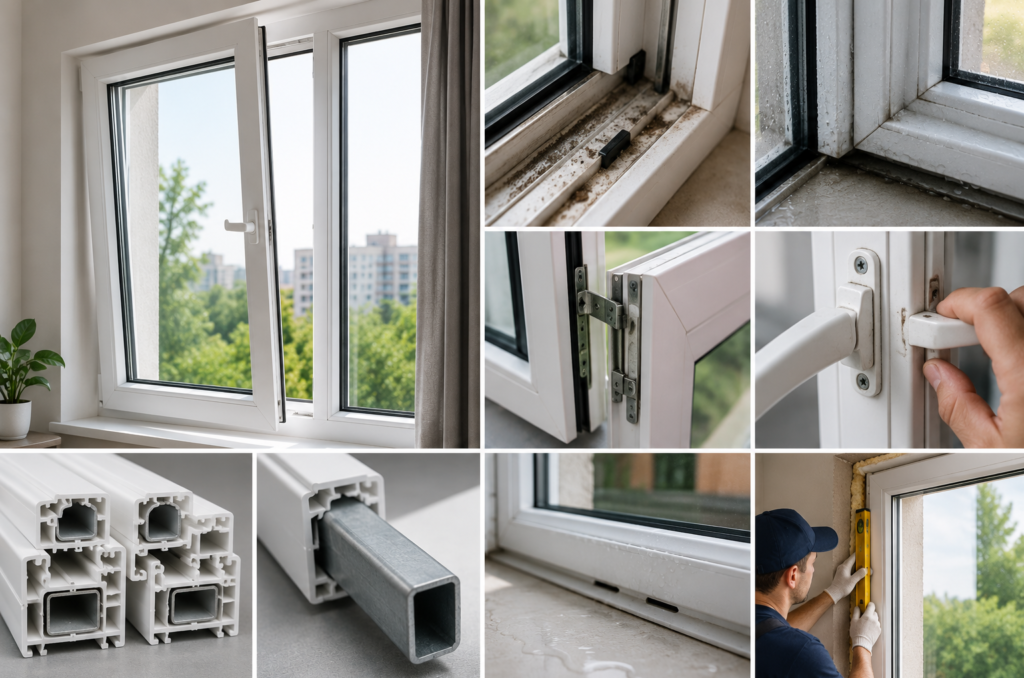
uPVC windows are widely used because they can provide a practical combination of durability, low maintenance and system flexibility. But a uPVC window is not a single component.
It is a complete assembly made from profiles, reinforcement where required, glass, gaskets, hardware, drainage provisions, fabrication and installation.
When something goes wrong, the visible problem may appear to be with the window itself, while the actual cause can be elsewhere.
For example:
- A sliding sash may become difficult to move because of dirty tracks or worn rollers.
- A casement sash may rub against the frame because of alignment or hardware issues.
- Water may enter because drainage or perimeter sealing is inadequate.
- A handle may become difficult to operate because of hardware or sash alignment.
- A frame may show dimensional problems because of fabrication or installation.
- A large opening may require more careful reinforcement and structural consideration.
Understanding these causes before buying or fabricating a window can prevent many avoidable problems.
1. Why Do uPVC Windows Develop Problems?
Most window problems do not come from one component alone.
The complete system involves:
Profile → Reinforcement → Fabrication → Glass → Hardware → Installation → Maintenance
A weakness at any stage can affect the final result.
For fabricators, profile consistency is particularly important because dimensional variation can affect cutting, welding, reinforcement insertion and assembly. Recent industry guidance for fabricators similarly highlights profile consistency as an important production consideration.
For homeowners, the important lesson is simple:
Do not judge a window only by the visible frame.
Look at the complete specification and how the system will be fabricated and installed.
2. uPVC Window Is Difficult to Open or Close
This is one of the most frustrating problems because the window may look completely normal while becoming increasingly difficult to operate.
Common causes
- Sash misalignment
- Hardware adjustment issues
- Worn hinges or friction stays
- Dirt around moving components
- Poor installation alignment
- Excessive sash weight
- Incorrect hardware selection
For casement windows, a dropped sash can cause the frame and sash to rub against each other. For sliding windows, resistance can come from the rollers or track.
Current maintenance guidance identifies misalignment, hardware wear and track contamination among common causes of difficult operation.
How to prevent it
The profile system, hardware and fabrication should be selected as a compatible combination.
During installation, the frame should be properly aligned and the sash should be checked for smooth operation before the project is handed over.
3. Sliding uPVC Windows Become Hard to Move
Sliding windows have a specific friction point that casement windows do not: the roller and track system.
Dust, grit and debris can accumulate in the track and increase resistance.
Other possible causes include:
- Worn rollers
- Incorrect roller adjustment
- Track damage
- Sash misalignment
- Excessive sash weight
- Hardware incompatibility
What should fabricators check?
Before final assembly, verify:
- Sash dimensions
- Track alignment
- Roller compatibility
- Sash weight
- Interlock alignment
- Frame squareness
For a sliding system, the profile, track and rollers need to function together.
VEKA, for example, offers different 2-track, 2.5-track and 3-track configurations depending on application requirements, demonstrating that sliding systems are not simply one universal profile arrangement.
4. The uPVC Window Does Not Close Properly
A window that does not close correctly can have several causes.
The first things to inspect are:
- Frame alignment
- Sash alignment
- Hinges or rollers
- Lock position
- Hardware adjustment
- Gasket condition
- Installation alignment
If the sash has shifted, the locking points may no longer line up correctly.
If the frame itself is not properly installed, adjusting the hardware may only provide a temporary solution.
The prevention starts during fabrication
Accurate cutting and welding help maintain the intended frame geometry.
UWDMA identifies precision machinery such as double-head mitre saws, welding machines, corner-cleaning equipment and assembly tables as part of uPVC window manufacturing.
This is why fabrication accuracy is not simply about appearance.
It directly affects how the finished window operates.
5. Water Leakage Around the Window
Water entering around a uPVC window can be caused by several factors.
Possible causes include:
- Blocked drainage openings
- Poor perimeter sealing
- Incorrect installation
- Damaged or poorly fitted gaskets
- Incorrect frame positioning
- Poorly executed joints
A properly designed window system needs a way to manage water that reaches the frame.
Drainage provisions are therefore an important part of the profile and fabrication process.
What should be checked?
During installation and inspection, check:
- Drainage openings
- Frame sealing
- External perimeter seal
- Gasket seating
- Sash closure
- Window alignment
A window should not simply be sealed shut everywhere. Water-management and drainage need to be considered as part of the system design.
6. Condensation Around the Window
Condensation is often blamed entirely on the window.
That is not always correct.
Condensation can be influenced by:
- Indoor humidity
- Ventilation
- Surface temperature
- Glass specification
- Room conditions
- Thermal performance of the complete window system
There is also an important difference between condensation on the room-side surface and condensation between the panes of an insulated glass unit.
Condensation between panes can indicate failure of the sealed glass unit rather than a profile problem.
This is why diagnosing the location of condensation is important before replacing the entire window.
7. Hardware Becomes Loose or Stops Working Smoothly
Handles, locks, hinges, stays and rollers are working components.
They experience repeated movement throughout the life of the window.
Common symptoms include:
- Loose handle
- Stiff handle
- Lock not engaging
- Sash not staying in position
- Worn hinge
- Sliding roller resistance
Hardware selection should therefore be considered together with the profile.
The hardware needs appropriate fixing points and compatibility with the profile geometry.
For example, a locking mechanism should not simply be selected based on appearance. Its dimensions, fixing method and compatibility with the profile system matter.
8. Sash Alignment Problems
A sash that appears lower on one side or rubs against the frame can create several secondary problems.
It can affect:
- Opening
- Closing
- Locking
- Gasket compression
- Hardware operation
- Finished appearance
Large or heavy sashes need particular attention because the hardware and reinforcement requirements can become more demanding.
A properly designed system should consider the opening dimensions, sash weight, glass weight, reinforcement and hardware together.
9. Why Reinforcement Matters in uPVC Windows
Reinforcement is one of the areas that should not be ignored when selecting a profile system.
uPVC profiles can contain a designated cavity for galvanized steel reinforcement where required by the system design.
The appropriate reinforcement depends on:
- Opening size
- Profile configuration
- Wind load
- Glass weight
- Window or door type
- Installation conditions
UWDMA guidance recommends checking galvanized steel reinforcement specifications and relevant structural calculations for uPVC windows and doors.
Government specifications also identify galvanized reinforcement in uPVC frames, sashes and mullions according to system requirements.
Fabricator takeaway
Do not ask only:
“Does this profile have reinforcement?”
Ask:
“What reinforcement does this profile accommodate, and when is it required for the intended opening?”
That is a much more useful technical question.
10. Profile Dimensional Consistency Can Affect Fabrication
This is a major friction point for fabricators.
If profile dimensions are inconsistent, the problem may appear later during:
- Cutting
- Welding
- Reinforcement insertion
- Glazing
- Hardware fitting
- Assembly
A small inconsistency repeated across a large project can create production delays and rework.
For this reason, profile quality should be considered from a fabrication perspective, not only from the finished appearance.
A fabricator should evaluate
- Profile dimensions
- Cross-sectional consistency
- Reinforcement cavity
- Welding behaviour
- Glazing compatibility
- Hardware compatibility
- Auxiliary profile compatibility
- Batch consistency
This is one of the reasons selecting the right profile manufacturer matters before starting bulk fabrication.
11. Poor Fabrication Can Create Window Problems
Even a technically suitable profile can produce a poor finished window if fabrication is inaccurate.
A typical fabrication workflow includes:
Measurement → Cutting → Reinforcement → Welding → Corner Cleaning → Machining → Hardware Fitting → Glazing → Assembly → Inspection
UWDMA identifies cutting, routing, welding, corner cleaning, glazing and reinforcement-related machinery as key equipment used in uPVC window production.
Common fabrication mistakes
- Incorrect cutting dimensions
- Poor mitre alignment
- Improper welding
- Incorrect reinforcement installation
- Incorrect drainage machining
- Poor hardware positioning
- Incorrect glazing
- Inadequate final inspection
The profile and fabrication process therefore need to be considered together.
12. Poor Installation Can Look Like a Profile Problem
A window can be fabricated correctly and still perform poorly if installation is not done properly.
Potential installation issues include:
- Frame not level
- Frame not plumb
- Incorrect fixing
- Excessive installation gap
- Poor perimeter sealing
- Drainage obstruction
- Sash misalignment
This is why a manufacturer, fabricator and installer each have different responsibilities.
The profile provides the system foundation.
The fabricator creates the window.
The installer integrates that window into the building.
13. How to Prevent uPVC Window Problems Before They Start
The easiest problem to fix is the one that never occurs.
Before purchasing or fabricating, check:
Profile
- Correct profile series
- Suitable dimensions
- Multi-chamber configuration
- Reinforcement provision
Glass
- Correct thickness
- Suitable glass type
- Compatibility with glazing system
Hardware
- Correct hardware type
- Profile compatibility
- Appropriate load capacity
Fabrication
- Accurate cutting
- Proper welding
- Correct reinforcement
- Proper drainage
- Correct glazing
Installation
- Frame alignment
- Correct fixing
- Perimeter sealing
- Proper drainage
Maintenance
- Clean tracks
- Check gaskets
- Inspect hardware
- Keep drainage paths clear
A complete system approach prevents many avoidable problems.
14. What Should You Ask a uPVC Profile Manufacturer?
Before purchasing profiles for a project, fabricators and dealers should ask specific questions.
Ask about the profile
- What profile series is suitable for my application?
- What are the profile dimensions?
- What is the chamber configuration?
- Is reinforcement provision available?
- Which reinforcement specification is recommended?
Ask about fabrication
- Which welding process is recommended?
- What hardware is compatible?
- Which glazing beads and gaskets are required?
- Are auxiliary profiles available?
- What drainage configuration is recommended?
Ask about supply
- What profile lengths are supplied?
- What colours and finishes are available?
- What is the minimum order quantity?
- What is the expected supply lead time?
- Is technical fabrication support available?
These questions can reveal much more about a supplier than simply asking for a price per kilogram or per profile length.
15. A Practical Problem-Diagnosis Table
| Problem | Possible Cause | What to Check |
|---|---|---|
| Sliding sash is hard to move | Track, rollers or alignment | Clean track, inspect rollers and alignment |
| Casement rubs against frame | Sash alignment or hardware | Hinges, sash position and frame alignment |
| Window does not lock | Hardware or alignment | Lock points, handle and sash position |
| Water enters during rain | Drainage or sealing | Drainage openings and perimeter sealing |
| Draught around window | Gasket or alignment | Gasket seating and sash closure |
| Condensation between glass panes | IGU seal failure | Inspect insulated glass unit |
| Handle becomes stiff | Hardware or alignment | Hardware adjustment and lubrication |
| Sash appears dropped | Hinge/stay or load | Hardware and sash alignment |
| Fabrication joints inconsistent | Cutting/welding/profile variation | Cutting accuracy and profile consistency |
| Repeated project rework | System incompatibility | Profile, hardware, reinforcement and fabrication process |
How Smart uPVC Window Profiles Address Fabrication Friction
For a profile manufacturer, solving the fabricator’s problems is more important than simply adding marketing features.
Smart uPVC Window Profiles are developed around practical fabrication requirements such as cutting, welding, reinforcement, glazing, hardware integration and assembly.
The objective is to provide profile configurations that fabricators can work with efficiently across different window and door applications.
The Smart range includes Casement, Premium Sliding, Eco and Auxiliary profile series, allowing fabricators to select systems according to the application and project requirements.
The focus is not simply on producing an extruded section.
It is on creating a profile system that works through the complete fabrication process.
Frequently Asked Questions
Why does my uPVC sliding window feel stiff?
The most common possibilities include dirty tracks, worn rollers, incorrect adjustment, sash misalignment or excessive resistance within the sliding system. Clean the track and inspect the rollers before assuming the profile itself is defective.
Why is my uPVC window not closing properly?
Possible causes include sash alignment, hinge or roller adjustment, hardware problems, frame installation and gasket compression.
Why does my uPVC window leak during heavy rain?
Blocked drainage, poor perimeter sealing, incorrect installation or gasket problems can contribute to water leakage.
Is reinforcement required in uPVC windows?
The requirement depends on the profile system, opening dimensions, wind load, glass weight and application. Appropriate reinforcement should be selected according to the system and structural requirements.
Why do uPVC window handles become stiff?
Hardware wear, sash misalignment, locking pressure, dirt or inadequate lubrication can make handles difficult to operate.
Can poor fabrication affect window performance?
Yes. Cutting, welding, reinforcement, drainage, glazing and hardware installation all contribute to the performance of the finished window.
Are all uPVC profiles compatible with the same hardware?
No. Hardware needs to match the profile geometry and system configuration. Compatibility should be confirmed before bulk fabrication.
How can fabricators reduce rework?
Use consistent profiles, accurate cutting, appropriate reinforcement, compatible hardware and a defined fabrication process. Final inspection before dispatch can also identify alignment and operation issues.