
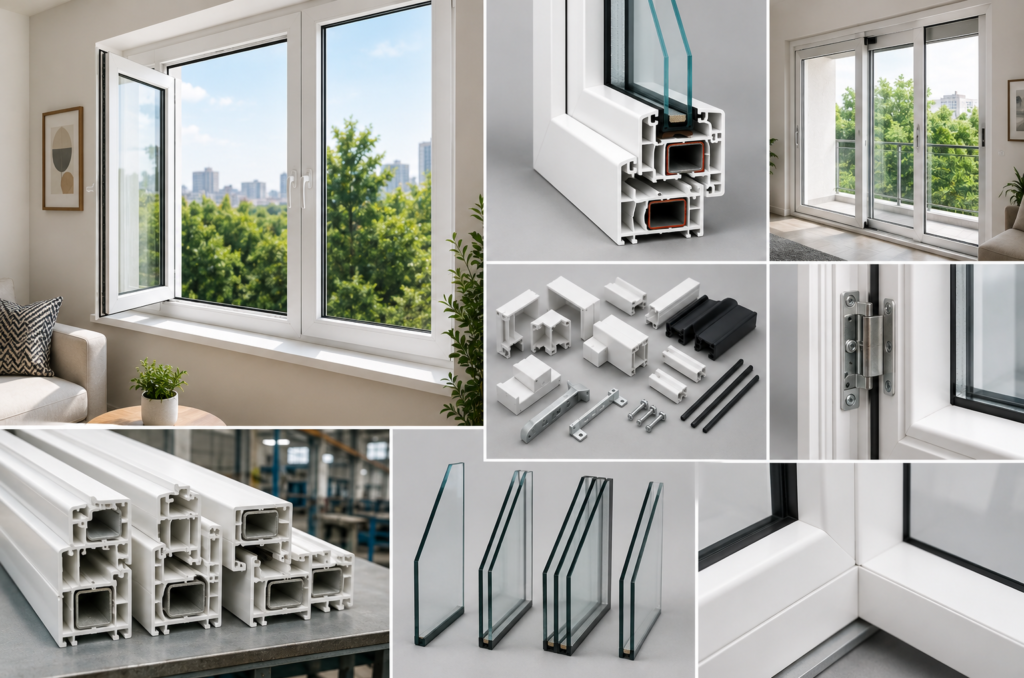
Choosing a window is not simply a decision between one frame material and another. The finished window is a combination of several components working together: the uPVC profile, reinforcement, glass, gaskets, hardware, fabrication and installation.
This is why two windows with the same overall size can have very different specifications and prices.
For homeowners, the important questions are usually simple:
- Which window type is suitable for my room?
- Is sliding or casement better?
- What profile should I choose?
- Is steel reinforcement necessary?
- Which glass is suitable?
- Why are two quotations so different?
- How much maintenance will the window require?
- How long can the system last?
For fabricators, builders and dealers, the questions go deeper into profile dimensions, reinforcement cavities, welding, glazing, hardware compatibility and fabrication efficiency.
This guide explains the complete selection process so you can evaluate a uPVC window system based on its actual specification rather than appearance or price alone.
What Makes a Good uPVC Window?
A good window is not determined by the profile alone.
It is a complete system consisting of:
- Profile system
- Reinforcement
- Glass
- Gaskets and seals
- Hardware
- Fabrication
- Installation
Each component has a different function.
The profile provides the main frame and sash structure. Reinforcement can provide additional structural support where required. Glass affects daylight, thermal behaviour, safety and acoustic performance. Gaskets help create the required sealing, while hardware controls opening, closing and locking.
Government specifications for uPVC windows and doors similarly describe systems using multi-chambered frames, sashes and mullions together with galvanized reinforcement, glazing beads, EPDM gaskets and hardware.
uPVC Windows in India: Why Profile Selection Matters
The profile is the starting point of the complete window system.
A profile is an extruded uPVC section manufactured with a specific cross-sectional design. Different sections are developed for different functions such as frames, sashes, mullions, transoms, sliding components and glazing beads.
The internal geometry of the profile can influence how it accommodates:
- Reinforcement
- Glass
- Gaskets
- Hardware
- Drainage
- Connecting components
A profile should therefore be evaluated according to the application rather than simply by looking at its external appearance.
For example, a large sliding door and a small residential casement window do not necessarily require the same profile configuration.
1. Choose the Right Window Opening Type
The first decision should be the opening style.
Casement Windows
Casement systems generally use hinged shutters that open inward or outward.
They are suitable when you want:
- Larger clear opening
- Direct ventilation
- Convenient cleaning access
- Effective sealing
- Flexible shutter configurations
Casement systems require suitable frame, sash, glazing and hardware configurations.
For fabricators, accurate cutting, welding, reinforcement and hardware preparation are particularly important.
Sliding Windows
Sliding systems move horizontally along tracks.
They are commonly selected where:
- Space around the window is limited
- A compact opening mechanism is preferred
- Larger glazed areas are required
- Balcony or utility openings need sliding operation
Sliding systems can use different track and sash configurations depending on the design.
The profile, rollers, track and interlock need to work together correctly for smooth operation.
Fixed Windows
Fixed windows do not open.
They are useful when the primary requirements are:
- Natural light
- External views
- Larger glazed areas
- A fixed architectural opening
Because there is no opening sash or operating hardware, fabrication requirements can be simpler than an openable window.
Special Opening Systems
Projects may also use tilt-and-turn, sliding doors, French doors or other specialized configurations.
The correct choice depends on the opening size, ventilation requirements, available space, hardware and project design.
2. Understand Multi-Chamber Profile Construction
Multi-chamber profiles contain internal cavities separated by profile walls.
These chambers are part of the overall profile design and can contribute to the system’s thermal and structural characteristics.
However, chamber count should not be used as the only measurement of profile quality.
When comparing profiles, also consider:
- Profile geometry
- Wall thickness
- Reinforcement provision
- Material formulation
- Glazing compatibility
- Hardware compatibility
- Fabrication requirements
- System design
Government specifications for uPVC windows specifically refer to multi-chambered profile systems and different profile series selected according to window or door size and wind-load considerations.
3. Check the Reinforcement Provision
Reinforcement is particularly important when dealing with larger windows and doors.
Steel reinforcement can be placed inside a designated cavity within the uPVC profile to provide additional structural support.
The required reinforcement depends on factors such as:
- Window dimensions
- Door dimensions
- Glass weight
- Wind load
- Profile design
- Installation conditions
- Application
UWDMA India recommends checking the galvanized steel reinforcement specification and the relevant static calculation when evaluating a uPVC window or door.
For fabricators, reinforcement should therefore be considered during the profile-selection stage rather than added as an afterthought.
4. Select the Right Glass
Glass is one of the most important variables in the finished window.
Common options include:
Single Glazing
A basic solution for applications where cost and standard performance are the main considerations.
Toughened Glass
Provides improved safety characteristics and is commonly considered for locations where stronger safety glazing is appropriate.
Double Glazing
Double-glazed units use two panes separated by a spacer and sealed into an insulated glass unit.
They can improve thermal and acoustic performance compared with basic single glazing, depending on the complete system and glass specification.
Laminated Glass
Laminated construction can provide additional safety and acoustic benefits depending on the glass build-up.
Solar-Control or Low-E Glass
These options can be considered when solar heat gain and indoor thermal comfort are important.
Current Indian market guides identify glass selection as one of the major factors affecting final uPVC window pricing, with double glazing and specialty glass generally costing more than basic single glazing.
The important point is that the best glass depends on the application.
A bedroom facing heavy traffic may have different requirements from a small bathroom window.
5. Do Not Ignore Hardware
Hardware controls how the window actually operates.
Depending on the system, this can include:
- Handles
- Hinges
- Locks
- Rollers
- Friction stays
- Multipoint locking systems
- Sliding mechanisms
Poorly matched hardware can affect operation even when the profile itself is suitable.
UWDMA recommends checking hardware construction, operation and locking systems when evaluating uPVC doors and windows.
For sliding windows, roller quality and track compatibility are particularly important.
For casement systems, hinges, handles and locking mechanisms need to work with the sash and frame configuration.
6. Check Gaskets and Sealing
Gaskets help create the seal between the profile, glass and moving components.
A proper sealing system can help reduce unwanted air and water movement through the window assembly.
EPDM gaskets are commonly specified in uPVC window and door systems. Government specifications specifically identify EPDM gaskets according to frame and sash profile requirements.
When comparing quotations, ask what gasket and sealing system is included rather than assuming all windows use identical components.
7. Consider Fabrication Quality
The same profile can produce different results depending on how it is fabricated.
A typical fabrication process can involve:
Measurement → Cutting → Reinforcement → Welding → Corner Cleaning → Machining → Hardware Installation → Glazing → Assembly → Inspection
Each stage can influence the final window.
Accurate cutting helps maintain correct dimensions.
Proper welding creates the frame and sash corners.
Correct reinforcement installation supports the intended structural design.
Proper hardware preparation helps ensure smooth operation.
Correct glazing and gasket installation contributes to sealing and finished appearance.
This is why the fabricator is an important part of the final window system.
What Is the Difference Between a uPVC Profile Manufacturer and a Window Fabricator?
This distinction is often overlooked.
A uPVC profile manufacturer produces the extruded profile sections used to make windows and doors.
A window fabricator purchases those profiles and converts them into finished window and door assemblies.
The fabricator performs operations such as:
- Cutting
- Welding
- Reinforcement
- Machining
- Hardware fitting
- Glazing
- Assembly
This means the quality of the finished window depends on both the profile system and fabrication process.
For builders and dealers, understanding this distinction makes it easier to evaluate suppliers and compare specifications.
How Much Do uPVC Windows Cost?
There is no single price for every window.
Current Indian market guides show wide price variations depending on profile grade, window type, glass, hardware, reinforcement, fabrication and installation.
The major cost factors include:
Profile
Different profile systems use different configurations and material quantities.
Glass
Glass selection can create a substantial difference in the final quotation.
Hardware
Basic hardware and advanced multipoint or specialized systems have different costs.
Reinforcement
Larger openings may require different reinforcement specifications.
Window Type
Fixed, sliding, casement and specialized systems involve different fabrication and hardware requirements.
Size
Larger openings generally require more profile, glass and reinforcement.
Fabrication
Cutting, welding, machining, glazing and assembly contribute to the finished cost.
Installation
Site conditions, fixing methods, sealants and civil work can influence the final price.
Because of these variables, comparing only the price per square foot can be misleading.
Why Are Two uPVC Window Quotations So Different?
This is one of the most common purchasing problems.
Two vendors may quote for the same opening size but use different:
- Profile systems
- Profile dimensions
- Glass
- Reinforcement
- Hardware
- Mesh
- Gaskets
- Fabrication specifications
- Installation methods
For example, one quotation may include basic single glazing while another includes an insulated double-glazed unit.
One may include galvanized reinforcement while another uses a different specification.
Therefore, before comparing prices, request an itemized specification.
Ask the vendor:
Profile series: Which profile system is being used?
Glass: What type and thickness?
Reinforcement: What specification is included?
Hardware: Which handles, locks, rollers and hinges?
Gaskets: What sealing material is being used?
Mesh: Is mosquito mesh included?
Fabrication: What fabrication process is included?
Installation: Is installation included in the quoted price?
This makes price comparison much more meaningful.
How to Choose uPVC Windows for Different Indian Conditions
India has significant differences in climate and building conditions.
Hot and Sunny Areas
Consider the orientation of the opening, solar exposure, glass specification and overall profile-glass combination.
Heavy Rainfall Areas
Pay attention to drainage, gaskets, installation sealing and water-management details.
High-Dust Urban Areas
Sliding tracks and hardware should be maintained regularly, while proper sealing becomes important.
High-Traffic Locations
Consider the combination of profile, glass and sealing system when acoustic comfort is a priority.
Large Openings
Pay particular attention to profile configuration, reinforcement, glass weight, hardware and structural requirements.
The correct system is therefore determined by the opening and application, not simply by the location name.
Maintenance: Are uPVC Windows Really Maintenance-Free?
uPVC windows are generally considered low-maintenance, but low maintenance does not mean zero maintenance.
The profile itself requires relatively simple cleaning, while hardware, gaskets, drainage paths and moving components still require attention.
Recommended maintenance includes:
- Clean profiles with mild soap and water
- Keep sliding tracks free of dust and debris
- Check drainage openings
- Inspect gaskets periodically
- Check handles and locks
- Lubricate suitable moving hardware as recommended
- Avoid harsh chemicals on profile surfaces
Recent Indian maintenance guidance similarly emphasizes cleaning, drainage checks, gasket inspection and hardware care as part of routine window maintenance.
Common Mistakes to Avoid
Choosing Only by Price
A cheaper quotation may contain different glass, reinforcement, hardware or profile specifications.
Selecting by Chamber Count Alone
Chamber count is only one part of profile construction.
Ignoring Reinforcement
Large openings require appropriate structural consideration.
Choosing Glass After the Profile
Glass and profile should be evaluated as a compatible system.
Ignoring Hardware
Hardware affects everyday operation and locking.
Choosing the Fabricator Last
A good profile system still needs accurate fabrication and installation.
Comparing Only the Frame
The finished window is a combination of multiple components.
A Simple uPVC Window Selection Checklist
Before placing an order, check:
- Window opening type
- Profile series
- Profile dimensions
- Multi-chamber construction
- Reinforcement provision
- Glass type and thickness
- Glazing compatibility
- Gasket specification
- Hardware specification
- Mesh requirement
- Drainage arrangement
- Fabrication method
- Installation scope
- Warranty terms
- Final price with applicable taxes
This checklist can help homeowners, builders, dealers and project teams compare quotations on the basis of actual specifications rather than marketing descriptions.
Frequently Asked Questions
Are uPVC windows suitable for Indian weather?
They can be suitable for a wide range of Indian conditions when the profile, glass, reinforcement, sealing, fabrication and installation are appropriately selected for the application.
Which is better, sliding or casement?
Neither is universally better. Sliding systems are useful where space and horizontal operation are important, while casement systems can provide larger opening areas and different ventilation characteristics.
Does steel reinforcement improve a uPVC window?
Appropriately specified galvanized steel reinforcement can provide additional structural support within the profile. The required reinforcement depends on the profile, opening, wind load and application.
Does a thicker profile always mean a better window?
Not necessarily. Profile geometry, material formulation, reinforcement provision, glazing compatibility, fabrication quality and the complete system should all be considered.
Is double glazing necessary for every uPVC window?
No. The appropriate glass depends on the project’s thermal, acoustic, safety, solar and budget requirements.
How can I compare two uPVC window quotations?
Compare the complete specification: profile, glass, reinforcement, hardware, gaskets, mesh, fabrication and installation. Do not compare only the price per square foot.
Do uPVC windows require regular maintenance?
They generally require relatively low maintenance, but tracks, hardware, gaskets, drainage openings and seals should still be inspected and maintained periodically.
Can uPVC profiles be used for both windows and doors?
Yes. Different profile configurations are designed for window and door applications. Larger doors require appropriate profile, reinforcement, hardware and structural considerations.